Your Respondents Are Speaking. Are You Actually Listening?
There is a particular irony baked into the market research industry. For decades, we have asked consumers what they think, what they feel, and what they want, then handed them a five-point scale and a text box to respond with. We called it capturing the voice of the customer. But in practice, we were flattening it into something far more manageable, and far less true.
That era is ending. And the brands still asking people to tick boxes are quietly falling behind the ones that have learned to actually listen. In an industry defined by consumer intelligence, survey innovation, and evolving market research trends, this shift is no longer optional.
The Gap Nobody Wants to Acknowledge
Here is the uncomfortable truth at the heart of traditional survey methodology: the format shapes the insight. When you compress a nuanced human opinion into a Likert scale, you do not capture that opinion, you reduce it until it fits. The frustration disappears. The hesitation evaporates. The delight flattens into a 4 out of 5. What remains is a number that represents a feeling but does not convey one.
Think about what actually happens when a consumer responds to a conventional survey. They pause, they self-edit, they choose the answer closest to what they mean rather than the one that is exactly right. The tone of voice that would have told you they were genuinely delighted… gone. The micro-hesitation before they said the price was "acceptable"… invisible. The specific frustration buried under a polite "somewhat dissatisfied"… lost.
Traditional surveys are extraordinarily efficient at collecting structured data at scale. What they are not efficient at is telling you why, and in a market where every brand is chasing the same data, the "why" is where the competitive edge lives. That is exactly why modern survey techniques beyond traditional questionnaires are gaining ground across global research teams.
The Shift Has Already Happened, in Your Respondents' Pockets
Consumers have not waited for the research industry to evolve. They have already moved. Voice surveys, voice notes, voice search, short-form video responses, and video surveys are now default modes of everyday communication for most adults.
According to PwC's Consumer Intelligence Series, as cited by Greenbook, more than 50% of people across all age groups, including those aged 50 and above, already use their voice to interact with technology daily. Voice is not a younger-generation preference. It is a human one.
This creates a structural problem for research teams still running text-first surveys. You are asking people to travel back to a format that feels increasingly unnatural to them, to share opinions about products and experiences they are living through in a very different way. The friction shows up in your data quality research, your completion rates, and the shallowness of the insights that come back.
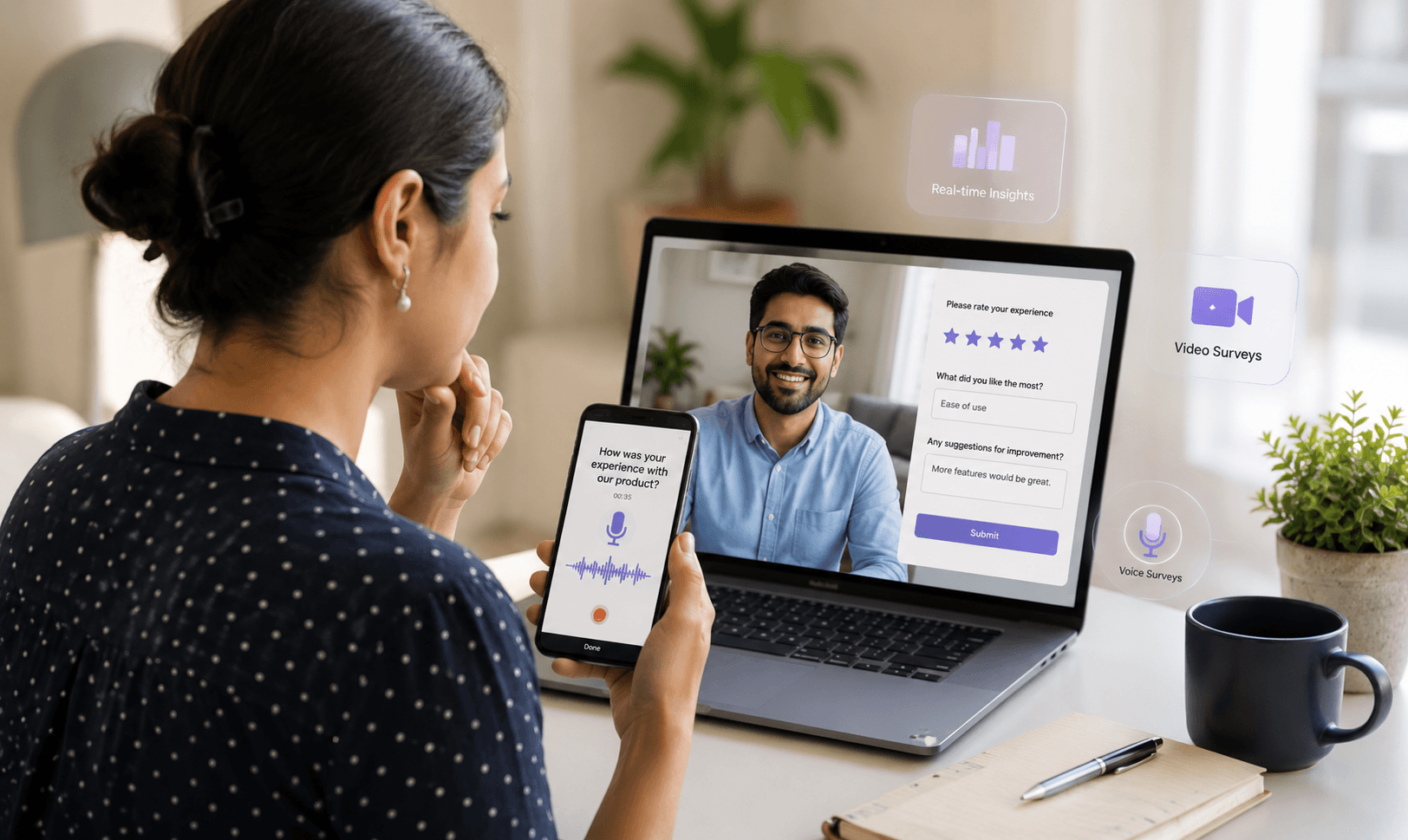
Voice and video surveys in market research meet respondents where they already are. They also unlock stronger consumer intelligence using voice-based surveys and more immediate customer insights from real moments, not overly edited text responses.
What You Actually Gain — and it Goes Beyond "Richer Insights"
"Richer insights" has become a vague phrase that obscures some genuinely transformative research capabilities. It is worth being specific about what voice and video surveys in market research unlock.
Emotional signal that text cannot carry. When a respondent records a video or speaks their answer, the data layer expands immediately. You hear the pause before they answer a question about a competitor's product. You hear the conviction when they recommend a brand to a friend. You see the expression that contradicts the polite rating they just gave. These are not peripheral signals, they are often the most commercially important part of what a consumer is telling you, and they are structurally invisible in a written survey. This is the essence of capturing emotional insights in consumer research and one of the clearest advantages of richer customer experience insights.
Authenticity that editing destroys. Written responses are curated. People read back what they have typed, soften it, and choose safer wording. Spoken and video responses, particularly asynchronous ones recorded on a respondent's own time, without a moderator present, are far more candid. As Greenbook has observed in its analysis of voice-enabled research, when people talk rather than type, they give longer, more in-depth responses, and voice communication conveys more nuanced, unfiltered, and emotional feedback by nature. This is where voice analytics, video feedback, and AI sentiment analysis in voice and video research begin to create measurable value.
Qualitative depth at quantitative scale. The historic trade-off in research was between depth and scale, you could have one but rarely both. Video and voice surveys dissolve this. You can deploy an open-ended video question to thousands of respondents globally, analyse sentiment and recurring themes across the full sample using AI, and still surface the individual stories that matter most for your stakeholders. This is not qualitative research with a bigger sample, it is an entirely new mode of inquiry. It is also how brands are now getting qualitative insights at scale with video surveys and stronger video surveys in market research insights without sacrificing speed.
Data integrity, built in. Video surveys carry a significant data quality advantage that is increasingly hard to ignore. As Quirks Magazine has noted in its analysis of video survey research methodology benefits, with survey fraud remaining a persistent industry challenge, the inclusion of video provides a direct verification layer, real people, in real time, giving real responses. Bots and bad actors cannot replicate that. This makes survey fraud prevention using video verification research an increasingly important part of modern research technology and a practical way of improving data quality using video survey tools.
Inclusivity by design. Text-based surveys consistently under-represent populations who are less comfortable with written language, respondents in second languages, lower-literacy participants, elderly audiences. Voice surveys remove these barriers entirely. People express themselves in the language and register that comes naturally to them. For genuinely global research, this is not optional. It is the difference between a representative sample and a skewed one. In that sense, inclusive research methods using voice surveys are not just more accessible; they are methodologically stronger.
AI Has Made This Scalable, and the Numbers Confirm It
The reason voice and video research remained a niche, expensive, qualitative-only tool for so long was the analysis bottleneck. You could collect the responses but processing them at scale required far too much manual effort to be commercially viable.
That constraint has gone. The Emotion AI market, which powers the sentiment analysis, tone detection, and facial expression analysis that makes voice and video surveys in market research scalable, is expected to grow at a strong pace from USD 3.34 USD billion in 2025 to USD 13.36 billion in 2032 at a CAGR of 21.9%, according to Markets and Data.
Modern platforms can transcribe speech to searchable text in real time, identify emotional peaks and troughs across thousands of video responses simultaneously, surface the dominant themes without manual coding, and deliver a synthesised output that is ready for a boardroom, not just an analyst's desk.
This is where AI powered voice analytics in market research becomes commercially meaningful. It also strengthens voice enabled survey technology consumer behavior analysis, giving brands a much clearer lens into motivation, hesitation, and emotional response.
The impact on research timelines is real and measurable. In a widely cited example from the industry, Subway's insights team used video surveys to evaluate a Super Bowl campaign and received results within 12 hours, a turnaround that would have been operationally impossible with any traditional methodology. That is not just a speed story. It is a decision-making story. When a brand can get consumer reaction to a live campaign within hours rather than weeks, the entire relationship between research and strategy changes. These are the kinds of real time consumer insights using video responses that are redefining AI in research.
Where This Creates Real Commercial Value
The most commercially sophisticated use of voice and video research is not as a standalone methodology; it is as the layer that sits on top of your quantitative work and makes it actionable.
Consider the classic NPS drop scenario. Your tracking study signals that loyalty has declined five points in a key segment. Your quantitative data tells you what happened. A video question deployed to that same segment within 48 hours tells you why, not as a hypothesis inferred from crosstabs, but as a direct, first-person, emotionally legible account from the people whose behaviour you are trying to understand. That is what moves from analysis to action.
Quirks has highlighted how video surveys are particularly powerful for product testing and in-store experience research, use cases where watching a real person interact with a product reveals friction points, unmet needs, and moments of genuine delight that closed-ended questions consistently miss. When a respondent shows you how they struggle to open your packaging rather than telling you they found it "somewhat inconvenient," the insight is of an entirely different quality.
This is also why video feedback surveys for customer experience research are becoming central to smarter customer feedback analysis using video survey platforms. Instead of relying only on abstract ratings, brands can observe emotional response, behaviour, and context directly. The result is sharper customer experience insights and more meaningful action.
The same logic applies to campaign pre-testing, concept evaluation, and brand health diagnostics. Voice and video do not replace structured data; they make it worth acting on. In practice, voice and video surveys in market research are helping brands move beyond passive reporting into deeper qualitative research that can shape decisions.
The Xcel Global Panel Difference
At Xcel Global Panel, we have built our capabilities around exactly this evolution in research methodology. Our panel infrastructure is designed for the diversity, scale, and authenticity that voice and video research demands, spanning markets, languages, and demographics that genuinely reflect the consumers your brand serves.
We combine a high-quality, rigorously verified global panel with the AI-enabled analysis infrastructure to turn spoken, human feedback into strategic insight, without sacrificing the speed or the scale that modern research programmes require. The richness of voice and video does not have to come at the cost of turnaround time. With the right panel partner, it should accelerate it.
That is especially true for brands looking to combine consumer intelligence, voice surveys, video surveys, and AI-led interpretation into a single modern workflow. From AI sentiment analysis in voice and video research to improving data quality using video survey tools, the opportunity now is not just to collect feedback, but to understand it in a more human way.
The brands that will lead in the next three years are not those with the most data. They are those with the most human data, the kind that captures what people actually feel, not just what they are willing to type into a box.
The Only Question Left
How many of your current research programmes are capturing the full picture of what your respondents are trying to tell you? If the honest answer is "not all of them," the follow-up question is simple: what decisions have you been making without the part of the story that voice and video would have told you?
The methodology exists. The technology is ready. The panel is here.
Ready to move beyond the tick box?
Contact Xcel Global Panel team and find out how voice and video surveys in market research capabilities, backed by a verified global panel, can transform the depth, speed, and reliability of your consumer intelligence.
Your respondents have more to tell you. It is time to give them the format to say it.